HYGINIST supports appraisers in testing Similar Exposure Group (SEG) compliance with an Occupational Exposure Limit Value (OELV), using series of exposure measurements.
For distributional compliance, HYGINIST estimates Time Weighted Average (TWA) exposure percentiles, such as the 95th percentile, below the OELVTWA, with or without a specified confidence. The approach is relevant to EN 689, BOHS/NVvA guidance and Leidel & Busch, NIOSH 77-173.
For long-term dose assessment, HYGINIST estimates the arithmetic mean and its upper confidence limit, based on methods described by Land and applied in occupational exposure assessment literature such as Scheffers et al. (1999).
HYGINIST also calculates probabilities for the OELV exposure categories of AIHA's Strategy Book, 4th edition, or alternatives within the Excel application IH-Aligner, using the noncentral Student distribution.
The probability-paper graphical tool, combined with the Shapiro-Wilk goodness-of-fit test, helps to establish which distributional shape has the highest likelihood and which reliable range of outcomes between lower and upper detection limits should be used in the exposure assessment.
Watch the YouTube video demos first: DEMO of HYGINIST and how to handle undetectables with HYGINIST.
HYGINIST can check the alignment of Bayesian linked priors on the SEG population location and dispersion with the sample GM and GSD, as used in tools such as Expostats and IHDA and the Advanced REACH Tool.
Download: press
download to retrieve the latest English version, or
download for the Dutch download page. Product information is available in
English and
Dutch.
Go top
Version 4.4.4 (January 2024)
- The period for use without registration is extended until December 31, 2025.
Version 4.4.0 (April 2019)
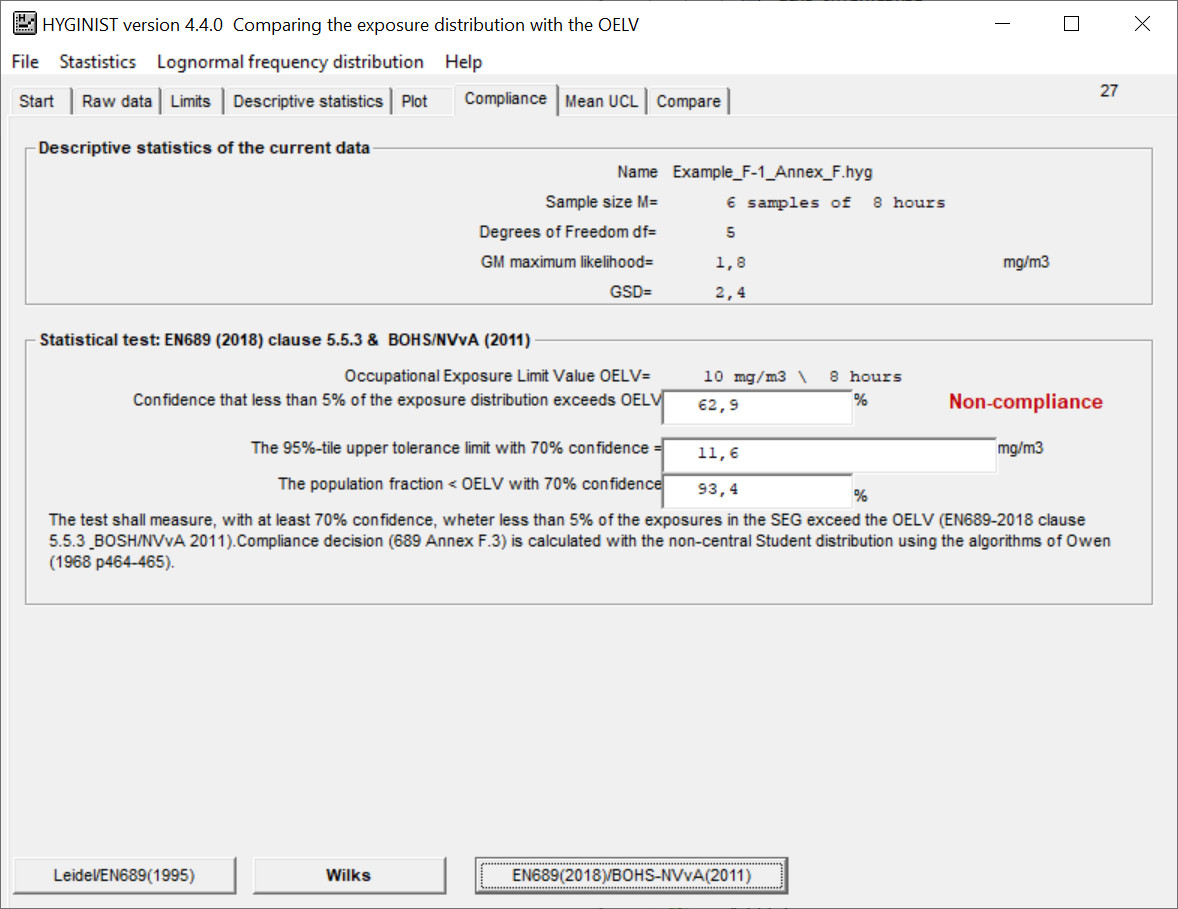
- The tab Upper limit UTL was changed to Compliance.
- Screen text was adjusted to the terminology used in EN 689:2018 + AC:2019.
- If confidence exceeds 70% that less than 5% of the exposure distribution is above the OELV, Compliance is indicated in green. Otherwise Non-compliance is indicated in red.
- A formatting error was removed for probabilities below 10E-23.
Earlier versions
- Version 4.3.8 (June 2017): text labels of the Upper limit UTL buttons were adapted.
- Version 4.3.6 (December 2016): HYGINIST Help, context-sensitive Help topics and Compare-tab labels were improved.
- Version 4.3.5 (January 2016): period for non-registered use changed to December 2016.
- Version 4.3.4 (January 2015): period for non-registered use changed to December 2015.
- Version 4.3.3 (May 2013): Help was converted to HTML Help, the program was made using Microsoft Visual Basic 6.0, and registration became advised and obligatory after December 31, 2013.
- Version 4.2.7 (April 2012): noncentral Student testing and 70% confidence as used in BOHS/NVvA and French approaches became central defaults.

Go top
The statistical evaluation of exposure measurement series is an essential element in working-conditions control and in assessing the health risk of inhaled chemicals.
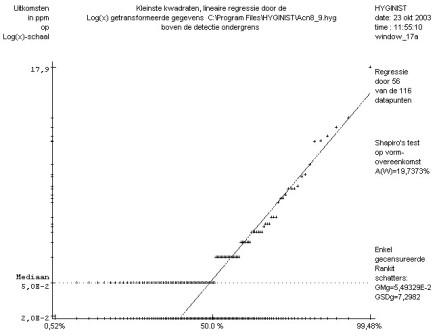
HYGINIST is a tailor-made industrial hygiene statistical tool. It evaluates exposure data collected with standard exposure-assessment strategies. It draws probability plots of three to two thousand data points and tests goodness-of-fit with the lognormal distribution.
In contrast to many other programs, HYGINIST helps to develop a cost-effective sampling plan, uses unbiased estimates for exceedance and non-compliance, and extracts maximum information from data below the detection limit.
If you need to evaluate environmental or personal air-sampling series, HYGINIST is intended to help you perform time-saving exposure evaluations of high quality.
Video demos: DEMO of HYGINIST and how to handle undetectables with HYGINIST.
Press HYGINIST to download the latest version of the program.
Go top
Detailed English product information
Occupational risk assessment and compliance control are often based on the evaluation of air-exposure data collected using baseline, compliance or worst-case surveys. For occupational hygiene professionals it is important that exposure data evaluation is swift, simple and solid.
HYGINIST provides the occupational hygiene professional with:
- a straightforward, easy-to-use, tailor-made program;
- small-sample state-of-the-art statistics;
- techniques desired by health-and-safety legislation and regulations in many countries;
- an industrial hygiene program free of charge.
HYGINIST can evaluate many combinations of exposure data and limit values. The ratio between sampling duration and limit-value reference period is normally the determining factor.
| Assessment and sampling strategy | Reference period OELV | Statistical evaluation |
|---|
| Percent exceedance or EN 689 statistical test. Random or stratified series of measurements. | 15 min to 8 hours | C95% or confidence that C95% is below the OELV. |
| Long-term dose of a chronic toxic agent based on random or stratified 8-hour measurements. | Long-term | Confidence that the arithmetic mean AMT is below the OELV. |
| Peak exposure control using grab samples or direct-reading equipment. | Ceiling | Confidence that the upper limit of the concentration distribution is below the ceiling value. |
Use HYGINIST in combination with generally accepted exposure-assessment strategies such as:
Raw exposure data can be entered by keyboard or loaded from a text file with the extension .hyg, as described in the manual. Loading data from disk saves time and reduces entry errors when evaluating larger series from dataloggers, databases or data-management programs.
HYGINIST draws a probability plot and corrects for tail error when using small samples. Different transformations can be compared visually and with the Shapiro-Wilk test.
When concentrations are below the detection limit, one half of the detection limit is often used as a dummy value. HYGINIST instead estimates descriptive statistics from the slope and mean of the regression line through concentrations within the detection range.
The program helps to calculate the smallest sample size for a long-term exposure assessment program and to establish the results of improved working conditions.
Windows that present calculation results can be appended to the HYGINIST.LOG report text file. Graphics can be copied using the Print Screen key or captured with a screen-capture program.
A review was published in the Annals of Occupational Hygiene: Dewell, 1995, Vol. 39, pp. 873-877.
The first English version of HYGINIST was released at AIHCe 1990 in Anaheim, USA.
HYGINIST should only be used when the sample can be considered randomly extracted from the exposure population under study. HYGINIST uses the lognormal distribution as a prior and offers graphical and numerical methods to test this prior.
HYGINIST is programmed in Visual Basic 6.0. It can be installed on Windows 95/98/ME/2000/NT/XP/Vista/7/8/10.
HYGINIST works in Windows 10 and earlier versions, both 32-bit and 64-bit. The conversion to VB6 and HTML Help makes installation of WinHlp32 obsolete.
Go top
HYGINIST is het computerprogramma voor het steekproefsgewijs plannen, interpreteren en toetsen van metingen in de werkplekatmosfeer.
HYGINIST is speciaal voor de arbeidshygiëne ontwikkeld. Het analyseert meetuitkomsten die verzameld zijn met standaard arbeidshygiënische strategieën en toetst deze tegen de grenswaarde.
Het programma helpt bij het kosten-effectief plannen van een meetprogramma, gebruikt zuivere schatters voor de kans op grenswaardeoverschrijding en haalt maximale informatie uit uitkomsten onder de detectiegrens.
Bekijk eerst de YouTube-demo's: HYGINIST DEMO en slim omgaan met meetuitkomsten onder de detectiegrens. Druk daarna op download voor de nieuwste versie.
Go top
Gedetailleerde Nederlandse productinformatie
Het beoordelen van het arbeidshygiënisch risico op werkplekken met blootstelling aan chemische stoffen is een wettelijk relevant onderdeel van de zorg voor arbeidsomstandigheden.
De evaluatie die HYGINIST toepast sluit aan bij grenswaardenregelingen en de Nederlandse/Europese norm NEN/CEN 689 voor het vaststellen van inhalatoire blootstelling aan chemische stoffen.
Meetgegevens kunnen via het toetsenbord worden ingevoerd. Meetseries kunnen ook als bestand worden ingelezen.
HYGINIST neemt het arbeidsintensieve tekenen op waarschijnlijkheidspapier over en corrigeert voor staartfouten.
Uitkomsten buiten het detectiebereik worden vaak weggegooid of krijgen een dummywaarde. De HYGINIST-methode schat statistische kengetallen uit lineaire regressie door de uitkomsten binnen het detectiegebied.
HYGINIST kan veel voorkomende praktijksituaties evalueren, waaronder grenswaardeoverschrijding, tijdgewogen gemiddelden, piekwaarden en lange-termijndoses.
| Vraag | Monstername | Referentieperiode | HYGINIST berekent |
|---|
| Blijft de momentane concentratie onder een piekniveau? | Kortdurend | Plafondwaarde | De betrouwbaarheid dat 95% van alle concentraties lager is dan de plafondwaarde. |
| Hoe vaak overschrijdt de gemeten concentratie de grenswaarde? | Ongeveer gelijk aan de referentieperiode | TGG van minuten tot uren | De kans dat TGG-perioden met concentraties boven de grenswaarde voorkomen. |
HYGINIST berekent de minimale steekproefomvang waarmee de kans op grenswaardeoverschrijding nog net voldoende laag is.
De HYGINIST-schermteksten en de bijbehorende handleiding zijn vanwege de internationale verspreiding in het Engels.
Schermen met resultaten kunnen worden opgeslagen in een HYGINIST.LOG-bestand.
Na een freeware voorloper, ARBSTAT, verscheen HYGINIST in 1990 in de publicatiereeks van de Nederlandse Vereniging voor Arbeidshygiëne. Na een posterpresentatie tijdens AIHCE-90 werd op verzoek van de AIHA een internationale Engelstalige versie ontwikkeld.
Standaard statistische software heeft vaak beperkte mogelijkheden voor het analyseren van lognormale verdelingen en uitkomsten buiten het detectiebereik.
Er is een interactieve workshop ontwikkeld over de achtergronden van HYGINIST en het kosten-effectief beoordelen van werkplekatmosfeer.
HYGINIST is gemaakt met Visual Basic 6.0 en draait op Windows 98/ME/2000/NT/XP/Vista/7/8/10.
Go top